
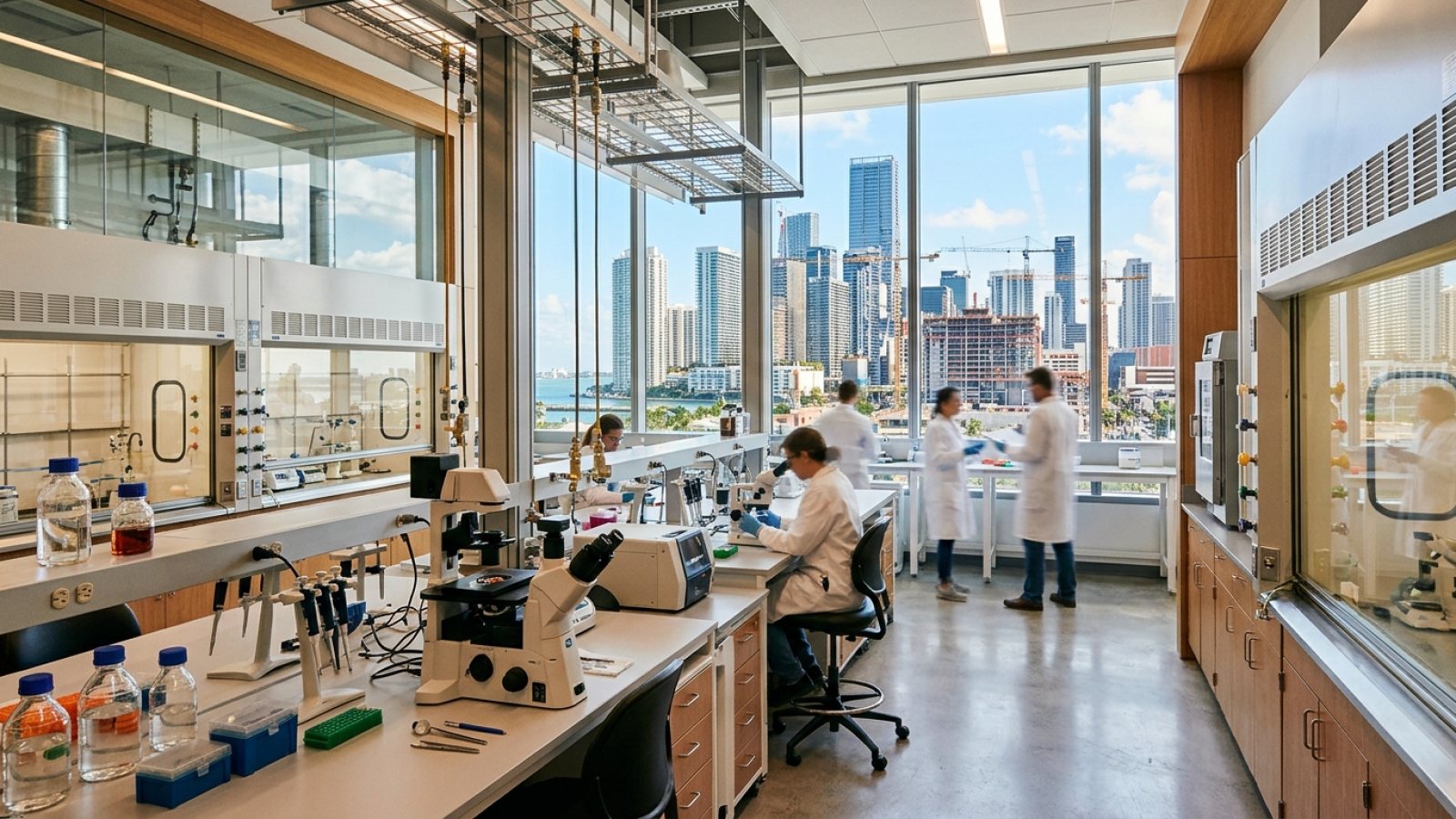
Miami's Life Sciences Real Estate Ascends: The Biotech Boom's Demand for Specialized Space
Miami's commercial real estate market is undergoing a significant transformation, driven by a surge in life sciences. This new demand for specialized lab and research facilities is reshaping development patterns and attracting substantial investment to South Florida.
Miami's commercial real estate narrative is rapidly diversifying beyond Class A office and luxury retail, with its latest, most capital-intensive chapter centered firmly on life sciences. What began as a nascent cluster of university-affiliated research facilities is now maturing into a robust, investor-grade asset class, commanding specialized development and drawing a distinct cohort of operators and capital.
The Catalysts: Academia, Capital, and Talent Migration
The University of Miami Health District (UMHD) remains the undisputed epicenter of South Florida's life sciences expansion. Institutions like the Miller School of Medicine, Sylvester Comprehensive Cancer Center, and Jackson Memorial Hospital have long formed a formidable research and clinical nucleus. However, the last five years have seen an acceleration driven by factors extending beyond traditional grant funding.
A significant influx of venture capital, initially attracted to Miami's burgeoning tech scene, has increasingly flowed into biotech and med-tech startups. This financial liquidity, coupled with a pandemic-accelerated migration of highly skilled talent – scientists, researchers, and biotech entrepreneurs – has created a critical mass. Miami's strategic position as a gateway to Latin America further enhances its appeal, offering unique opportunities for clinical trials, pharmaceutical distribution, and medical tourism that attract both international investment and a broader talent pool.
The Evolving Asset Class: Beyond the Bench
Life sciences real estate is not merely office space with a few extra sinks; it is a highly specialized product type with stringent infrastructure demands. Wet labs, crucial for biological and chemical research, require robust ventilation systems, fume hoods, specialized plumbing for hazardous waste, and enhanced power loads. Dry labs for computational biology and bioinformatics, along with animal facilities (vivariums) and cleanrooms, each present distinct challenges and cost escalations.
This specialization translates directly to development costs and, consequently, lease rates. Ground-up construction for a modern lab facility can range from $300 to $700+ per square foot for shell and core, with tenant improvement allowances often exceeding Class A office standards by a factor of two or three. Consequently, effective rents for purpose-built lab space within submarkets like UMHD are now commanding rates often 20-30% higher than prime Class A office, typically in the $65-$95 NNN range, before factoring in significant tenant build-out. Investor interest has mirrored this growth, with cap rates for high-quality, long-term leased life science assets tightening, often settling in the 5.5% to 7% range, reflecting their perceived stability and specialized nature.
While UMHD is the clear anchor, other areas are gaining traction. Doral, with its proximity to Port Miami and MIA, is emerging as a critical hub for cold-chain logistics, pharmaceutical manufacturing, and distribution facilities — a complementary but equally vital component of the biotech ecosystem. Developers with deep expertise in this sector, such as Wexford Science + Technology and Breakthrough Properties, are actively exploring or executing projects, understanding that success hinges on precise infrastructure delivery and a nuanced understanding of scientific user needs.
Navigating the Headwinds and Future Growth
Despite the undeniable momentum, Miami's life sciences real estate market faces its own set of challenges. The high cost of specialized construction, coupled with a competitive labor market for skilled trades, creates significant barriers to entry for inexperienced developers. Furthermore, the sustained growth requires an equally robust pipeline of highly specialized talent, necessitating ongoing investment in education and a keen eye on the region’s broader affordability crisis, which impacts all segments of the workforce, including researchers and technicians.
Infrastructure remains another critical consideration. Life science facilities demand reliable power grids and efficient transportation networks, both of which are under constant pressure in South Florida. Climate risk, though a broader issue for all real estate, takes on added weight when housing irreplaceable research data and sensitive equipment.
Nonetheless, the tailwinds are substantial. Global demographic shifts, an aging population, and continuous advancements in medical innovation ensure sustained demand for R&D and manufacturing. Miami's unique position, bridging North and South American markets, promises continued growth in areas like contract research organizations (CROs) and personalized medicine, further solidifying its role as an international biotech destination. This sector is not a fleeting trend but a foundational shift for South Florida’s economy and its commercial real estate landscape, demanding sophisticated strategy and long-term capital commitment.
